
Insight application analysis as the basis
for the future of your legacy environment
Within a constantly changing technology landscape businesses have to adapt, future proof or replace their historically grown and individually tailored legacy systems – their DNA – to and for modern requirements. Insight application analysis helps because it is a valuable solution that optimises application documentation, collates background knowledge about the application, transfers know how to new developers and creates modernisation plans that reflect individual application components’ complexity.
Application background knowledge
Improved code quality
Pre-defined and individual reports
Creation of modernisation plans
Provides the basis for decision making across your business
Universal analysis solution
Your response to legacy challenges
Insight offers a solution to all these challenges. It comprehensively analyses and provides application documentation with regard to structure, logic and system component functionality. This provides the basis for targeted future proofing and planning across mainframe systems such as z/OS (MVS, OS390), VSEn and iSeries (AS/400) as well as decentralised operating systems. Insight covers programming languages including COBOL, PL1, Natural, C, Assembler and FORTRAN. In addition, the product allows you to draw on information from further technologies such as CICS, IMS, DB2 and ADABAS.
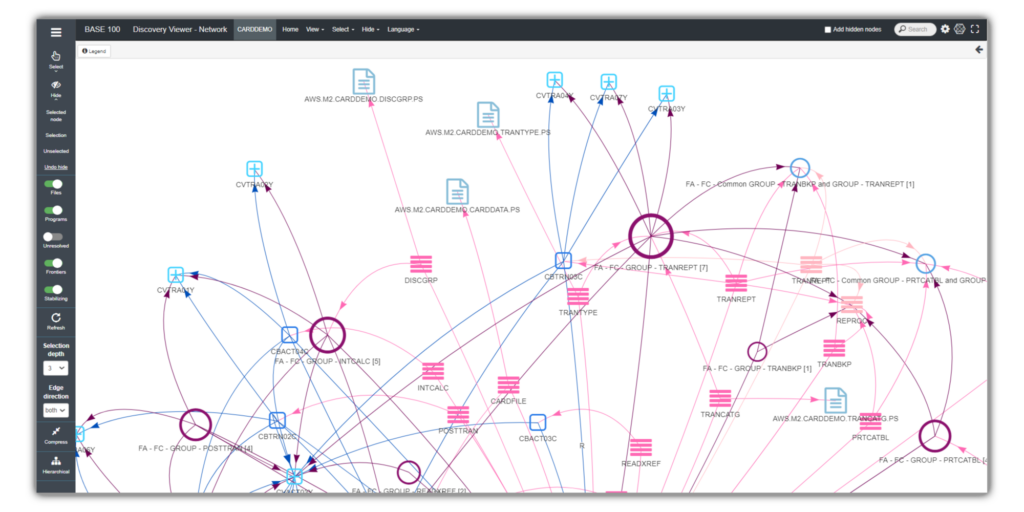
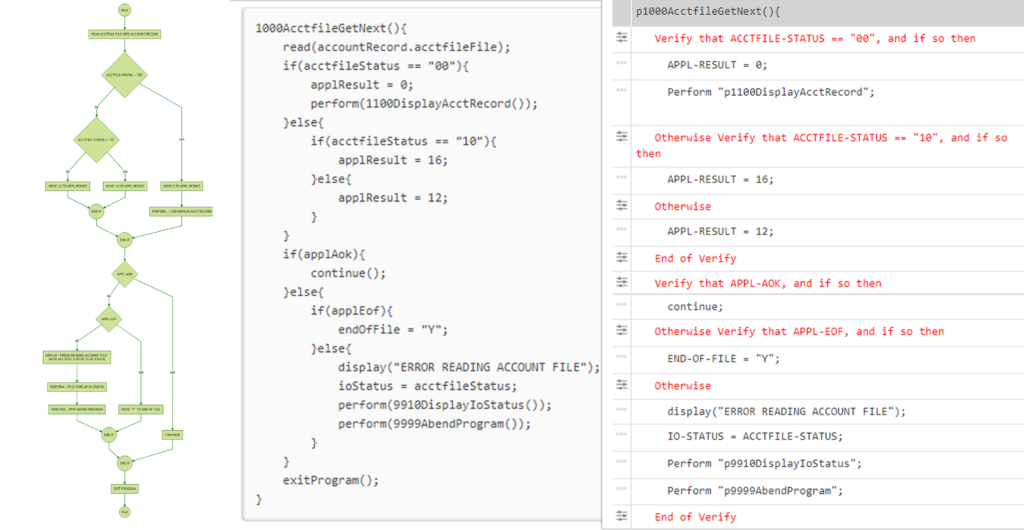
Insight application analysis creates a detailed and objective repository of information encompassing all system objects. It generates precise flow charts and Java pseudo-code while extracting business rules from the legacy application. In their totality, these elements comprehensively explain the application’s functionality and form a reliable and useful basis of information for any required adaptation. It not only creates a visual and interactive picture of the system, it also allows in-depth exploration of how the system works.
No matter whether you are preparing a modernisation, a re-development or a move to standard software, Insight application analysis ensures that your legacy application is ready for the future.

Comprehensive documentation with Insight application analysis
A hallmark of Insight is the exceptional quality of the legacy system application documentation it produces. Not only does it generate extensive and usable documentation that allows technical teams to constantly stay up to date, it also captures every detail of the system. Insights go beyond basic information depicted in various interactive display options to deliver in-depth application documentation that covers every aspect of the system. It generates detailed documentation for each component and divides the component into different sections.
Through this detailed and comprehensive examination the tool provides a quick overview of the whole system – from its overarching structure all the way to its specific components. It creates detailed component and interface lists that include important information such as name, purpose and version number. The programme documentation gives an overview of structures, calls and variables used that eases maintenance tasks with access to the required background knowledge about the application. Insight elevates application documentation to a new level.
Gain application background knowledge
In addition to creating an inventory of objects, Insight is also a key tool to deepen your background knowledge of applications and to develop a full understanding of legacy systems. It offers a functional overview that clearly shows what a process does and why, and in doing so it identifies the related business procedures. Pseudo code and flow charts visualise the function and in addition it is possible to extract business rules. In totality, Insight makes the legacy functionality tangible and comprehensible.
This detailed specification which encompasses functionalities, business rules, data structures and interfaces enables the tool to offer you a foundation for future facing decision making and planning. It allows businesses to objectively evaluate the chosen path, no matter whether that is modernisation, re-development or replacement by a standard solution. This evaluation uses the extracted specification to ensure that the business logic and functionalities of the legacy application are properly depicted.
What is more, the specifications Insight develops support targeted data migration. This is because the specification clearly sets out which data is required for which structure, which in turn makes it easier to compare the chosen future solution with the existing application. Adaptations, migrations and conversions can all be efficiently conducted. Additionally, you can review and adapt integrations with both internal and external systems.
Finally, Insight also enables businesses to plan comprehensive testing and approval procedures which guarantees the coherence of business processes, data structures and interfaces between legacy and future solutions.
Functionality documentation captures legacy functionality and makes it accessible for every developer.
Improved code quality
Insight’s features improve the optimisation processes for legacy systems’ code quality, architecture and organisation. These features’ goal is to increase code quality through cleaning, component formation and best practice implementation.
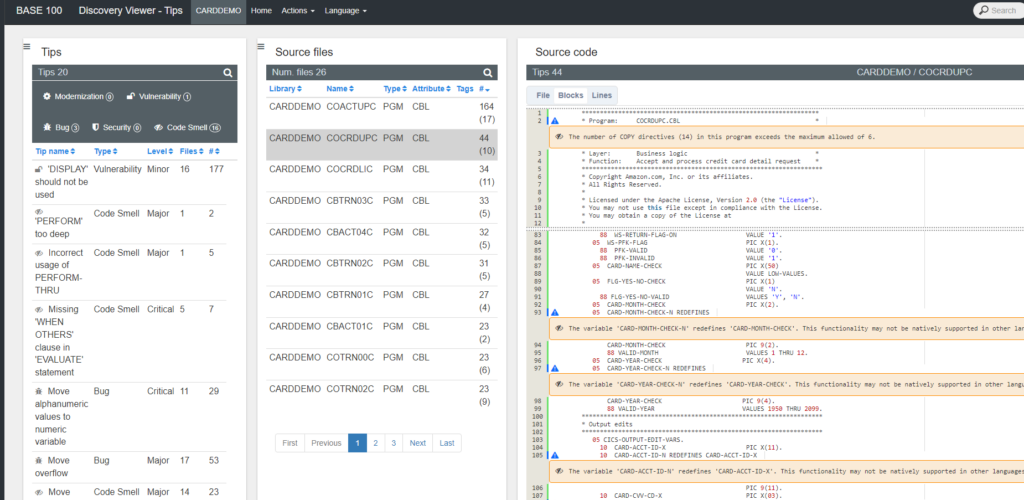
One key pathway for doing this is reducing the number of rows of code by improving the structure of sequences and optimising organisation. Insight uses standardised functions to support application homogeneity and highlights any areas that are overly complex. It identifies critical code quality problems – from inconsistent instructions over type misalignments to unreachable or duplicate code. Insight application analysis formulates best practice informed recommendations and helps to isolate and identify reusable components with the goal of designing the code in an efficient and manageable way.
Pre-defined and individual reports
Insight application analysis comes with a remarkable collection of pre-defined reports that have been developed with the express purpose of reducing the complexity of legacy systems. Included in the reports are aspects like system statistics and structure but they importantly also offer deep programme insights. The reports cover everything: from missing and unsolved elements over detailed node information to continuously updated technical documentation.
Other than such standard reports, Insight has the option of defining individual reports that meet specific requirements. Such extensive reporting functions gives users the means to understand their legacy systems, and to maintain, improve and modernise them while ensuring access to all relevant data.
Creating modernisation plans with Insight application analysis
Insight helps with the creation of modernisation plans. Following an initial analysis of functional groups, Insight guides you in the development of an implementation plan structured in waves. Such a sequential waves approach reduces the risks of a big bang approach and eases the transition from old to new. The creation of clusters based on the functional groups is one central hallmark of this approach. Such cluster analysis brings interdependencies to the fore which in turn determines the right moment for each cluster’s implementation. The implementation process’s complexity is a function of how strong relevant interdependencies are: it is best to start with groups with fewer interdependencies, which results in a faster and better modernisation process.
Carefully considered planning like this is key for every legacy application’s successful future.

Providing the basis for decision making across all areas of your business
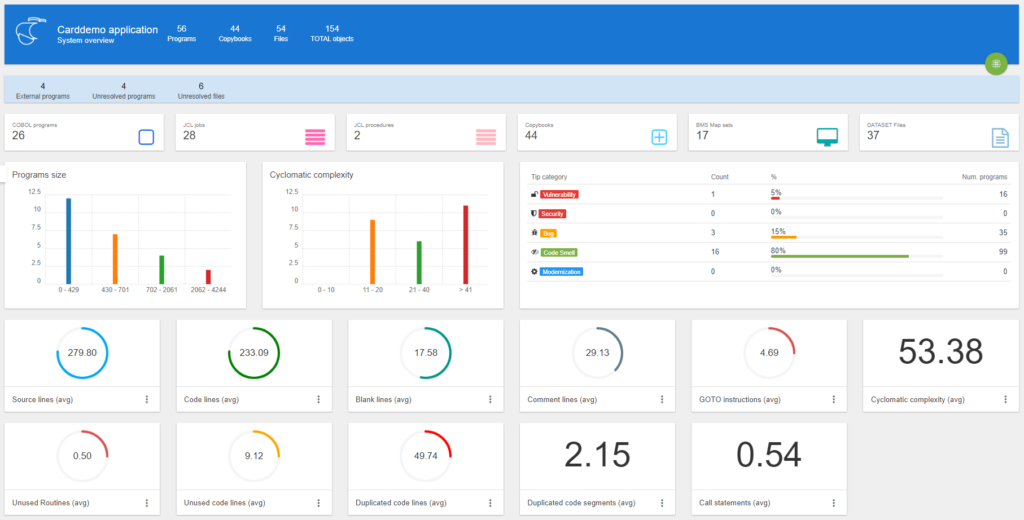
What is more, information and data collated by Insight application analysis gives useful insights for all areas of your business, be it senior management, IT or technical departments. The tool replaces intuition with objective and detailed decision making information in the form of application background knowledge. This knowledge positions your teams to take sound and clear strategic and operative decisions. Varied dashboards and drill downs allow every team to access just the right information at the right time to act effectively and in a targeted manner.
Universal analysis solution
Insight is a comprehensive and universal solution to analyse and document complex IT systems. It recognises and analyses hybrid systems created with multiple languages, tools and technologies. In doing so it goes beyond merely documenting programmes in the legacy application by also integrating operating system tools, utilities and specific components. All of this means Insights is an essential tool for all IT experts.
Its ability to recognise every call, even calls between different technologies, distinguishes Insight from its competitor solutions.
A further unique selling point is Insights’ compatibility with various ways of coding. Given ever increasing levels of diversification and comprehensiveness among IT systems, Insights is a universal solution for specialists who need to stay ahead of the game.
Case study
An international financial services provider with over 30 years of trading history needed to modernise its aged mainframe systems. Written mainly in COBOL and having grown over the decades, system application documentation was patchy and widely distributed.
The company opted for EasiRun and Insight as a provider-solution combination to conduct an exhaustive analysis of its legacy systems, create comprehensive system documentation and gain detailed application background knowledge. Following thorough examination, all system objects were captured and documented. Flow charts and Java pseudo code were generated and business rules were extracted to visualise application functionality in a modern and accessible way.
Based on the insights generated, the company could evaluate three main options: modernisation, re-development or replacement with a standard solution. Taking into account the detailed specifications provided by Insight, the company eventually opted for a combined solution: to modernise some key components and replace others with modern standard software.
Implementation took place iteratively to speed up the modernisation process, starting with objects with fewer interdependencies. In parallel, we developed interfaces between modernised components and the new standard software, thus guaranteeing a seamless integration.
As a result, the company gained a modernised, efficient and future proof system that meets current and future requirements of the financial markets. The use of Insight accelerated the modernisation process, minimised related risks and saved substantial costs.
Conclusions
Insight application analysis has become an excellent tool for any business faced with the monumental task of understanding its legacy systems and collating, documenting and future proofing its applications. It offers in-depth analysis and comprehensive documentation of old systems, and lays the foundations for targeted future facing strategies.
It connects IT experts with business departments by considering both technical and subject matter related aspects of systems. Doing so enables sound, data-driven decision making instead of relying on intuition.
In the context of a constantly evolving IT landscape in which businesses have to search for the most efficient solutions to stay ahead of the game, Insight is key. It is an indispensable tool for sustained and successful planning and implementation of future proofed legacy applications.
Complete application documentation