Do you need to manage millions of transactions per second on a single data base server? Are you struggling to achieve the performance you need with SQL? What if you could replace SQL with any language of your choice and gain control of your data base, its performance and costs with just a few extra lines of code?
FairCom DB allows you to access your data from two directions at the same time: you can continue to use SQL just as before while simultaneously drawing on FairCom DB’s API interfaces to quickly access data in ways that meet your specific requirements. FairCom DB is ideal for large business critical, core applications that rely on high levels of performance, reliability and scalability. To get what you need, you can adapt FairCom DB to your specific criteria. This adaptability gives you the data base you need, quickly, reliably and efficiently.
A real multi model data base
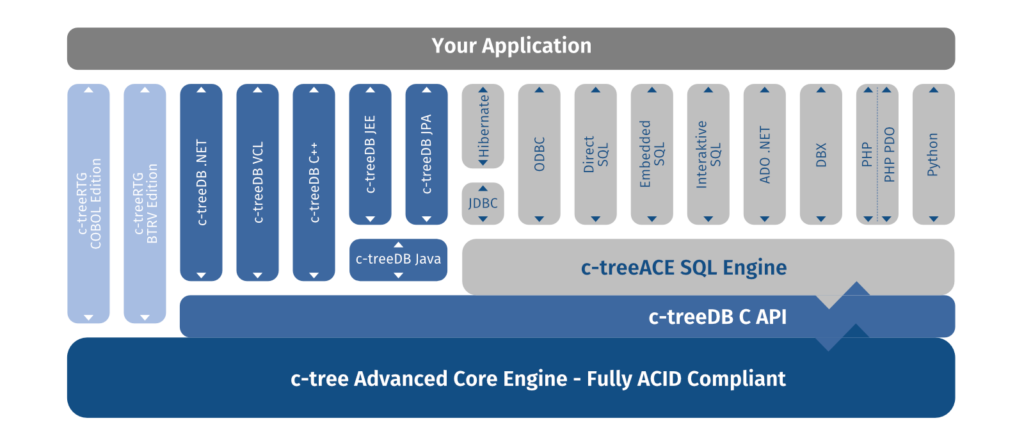
The FairCom DB Engine has all the important functions of any other business data base, and more. They include, ANSI SQL, ACID transactions, high levels of availability, parallel multithread processing, encryption, conditional indices, triggers, partitioned tables and many more. It also offers functions of no-SQL data bases, such as JSON, relaxed transaction processing, eventually consistent data and indices, and others. How is it possible to develop one single application that uses the best characteristics of NoSQL and SQL? The secret of FairCom’s seamless multi model integration of NoSQL and SQL is the unique, multi-layer API. Many data base basics – such as ACID-compliant transactions, locks on row and key levels, deadlock recognition and more – are implemented in the lowest common denominator API, the NoSQL API. This allows you to combine and adapt any number of the above interfaces. What’s more, you can do this in one and the same set of NoSQL data without fear of deadlocks or other interruptions from other users. The image below illustrates the options to access FairCom DB data. APIs and frameworks fall into two categories: first, No SQL APIs, in blue, and, second, SQL APIS, in grey.
SQL APIs – the advantages of using SQL
NoSQL APIs - the advantages of using NoSQL
The SQL APIs offer hassle-free data integration that meets industry standards for your entire business, including third party applications, websites, mobile applications and much more. FairCom DB SQL APIs are based on widely used standards. That means it is easy to find programmers and DB administrators who are familiar with these APIs. By drawing on the various available options, you can tailor access to SQL data to meet all your application requirements. For instance, you could consider Python for new Linux-based development, PHP for traditional web access and ADO.NET for Windows-based desktop applications. And don’t forget that you can also access data in less traditional, NoSQL sources.
Gain even greater control than with SQL APIs. You have access to a complete API library in C, C++, ADO.NET or Java depending on your specific requirements. This library provides you with expanded lock controls and access to database keys and reduces your dependency on data schemas. One of many advantages of the high levels of flexibility and control offered by NoSQL APIs is the ability to dynamically capture data without the need for strict schema rules. Direct API data access to the record level makes many activities easier while the size of your application is only marginally affected. All of this together increases throughput on a NoSQL level compared to what would usually be possible on a relational level.
Further FairCom DB technical highlights
Heterogeneous networking
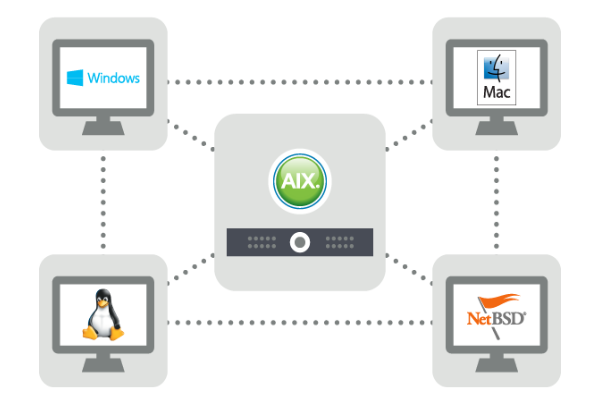
Often applications running on different platforms need to process the same information. FairCom DB’s heterogeneous networking supports clients and servers with varying architectures to use the same database. As an illustrative example, with FairCom DB a Unix server can give multiple different user applications running on Unix, Mac and Windows clients read and write access to the same database.
Multi-server support
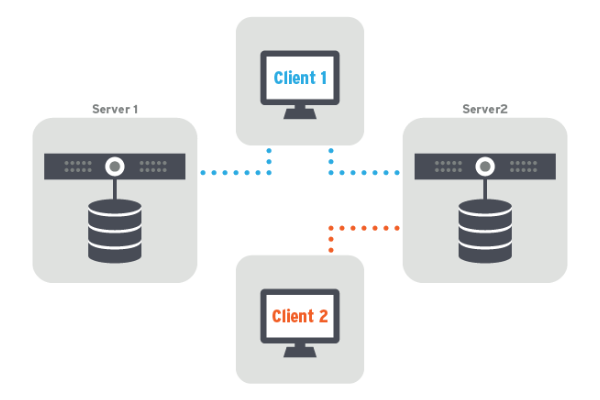
Connect a single client process with multiple FairCom DB database engines simultaneously. For example, you could connect a Windows client process with a Windows TCP/IP server, a pSeries TCP/IP server and a Mac OS X TCP/IP server at the same time. What’s more, FairCom’s unique local library support enables the client process to connect with a single user database or a multi-user non-server FairCom DB library. This gives the client process access to data within its own process. The resulting ability to read local data and network data across multiple servers provides the client with unparalleled data access and flexibility. In addition, FairCom DB’s unique approach allows for almost seamless migration of database backends to most of the prevalent operating systems including Windows, Macintosh, Linux and most Unix platforms. One FairCom client migrated an application, and all relevant data, hosted on Windows to a SPARC back end with c-tree server in just a single day.
Communications protocol
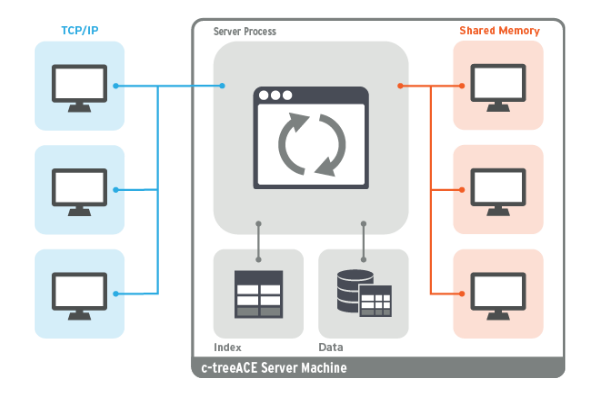
FairCom DB supports both the standard TCP/IP communications protocol and shared memory. Shared memory opens some of the available memory to multiple processes. Shared memory communication between FairCom DB clients and servers on the same computer improves the performance of applications running locally.
Replication manager
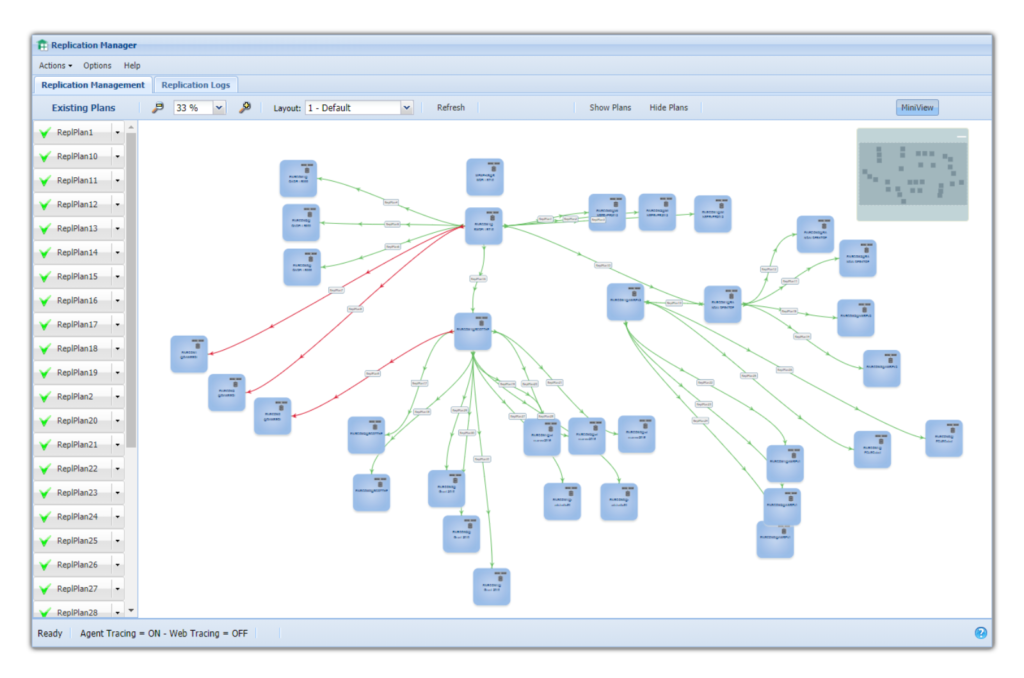
Data replication is a flexible and foundational concept underpinning safe and secure availability and scalability. The replication manager – a browser-based user interface – runs centrally to configure, manage and monitor data replication across hundreds of servers and thousands of tables and files. FairCom replication is automatable through a JSON/HTTP Web Service API and C/C++ API. The replication manager makes it easier to combine replication and failover to create data base clusters that are tailored to your needs. With replication manager you can easily create many different high availability and disaster recovery scenarios.
Why FairCom DB NAV?
What is NAV? NAV is an object oriented, next generation, data set navigation API based on a relational data base model. It is the result of FairCom’s four decades of research and practical experience working with Fortune 100 companies and their most critical real time applications. The latter includes processing VISA transactions or UPS packages, analysis of stock exchange transactions, worldwide forwarding of mobile phone calls and many more. NAV provides unparalleled control with levels of performance that other data bases cannot match.
With NAV API you get quick, indexed access to relational datasets in tables. Unlike any other data base, you determine what is indexed, from a low level. Your code can cycle through an index forwards or backwards, it can look up a value in an index, batch process data sets between two positions on an index, save positions in an index, jump back to saved positions, use saved positions to recover a set of data sets without looking them up in indices and so on. You’re able to access datasets either in the sequence in which they are saved in a table or in a sorted index sequence. You have full control. Because NAV is completely relational you can model data just the same as in SQL data bases: by using tables, rows, columns, primary keys, foreign keys, schemas, limitations and so on. NAV hands you complete control of all four ACID attributes: atomicity, consistency, isolation and durability. NAV does this through its complete control over locks and transactions while navigating through the data. Additionally, NAV enables you to define your own data processing algorithms to meet specific performance, scalability, availability and consistency requirements. No other SQL or NoSQL data base reaches NAV’s level of control which leads to maximum performance. FairCom developed NAV to meet the needs of C++, Java, .NET and Node.JS developers who rely on high performance. Often, these developers find themselves frustrated by other data bases that do too much and come with too many requirements. Despite the control that NAV offers it is easy to use. It is object oriented and intuitive. It has sensible standard settings such as automatically sticking to ACID transactions until and unless you need to alter settings.
DocGraph – GQL feature
FairCom DB’s current roadmap includes the innovative addition of DocGraph. In this addition to the non-relational DB you navigate through available data via a diagram. In this approach, meta data, data sets in tables and data set fields define different aspects of the diagram, from edges and nodes to relationships and graph attributes. Data set fields can contain JSON and XML documents. New indexes are used for multi-value columns, nested tables and diagram relationships between documents. Schemas illustrate document rules and graph relationships. FairCom is a member of the ANSI SQL committee working to define the new language GQL: Graph Query Language.