
Best-in-class automation

Automation is key to improving efficiency and productivity in today’s IT environment. Organisations can use self-service, process automation, job control and job scheduling to optimise their procedures and reduce burdens on IT departments. With OpCon, SMA Technologies offers a high-performance solution for process automation which can progress your digital transformation and automate all your IT processes – from day-to-day tasks all the way to complex high-risk processes. OpCon allows you to automate and modernise technical workloads for virtual and Cloud environments, be it stand-alone or across whole systems or infrastructures. Familiarisation with this intuitive solution is easy and ensures a quick return on investment and while minimising errors. OpCon deploys IT processes quickly and simply which avoids the creation of shadow IT systems. What is more, selfservice technology guarantees easy access also for non-technical business departments.
Advantages
Reduce errors and outages
Reduce shadow IT
Gain oversight and control of your IT and your know-how and reduce risks
Maintain oversight of all processes and benefit from auditable proof
Automate your emergency recovery systems
Quicker IT deployment with specialist deploy and self-service functions
OpCon - Your advantages
- Improve your organisational resilience
- Your business becomes more agile and can grow better
- Automate upgrades and maintenance processes
- Self-service functions reduce the burden on your internal IT support
- Close qualification gaps by embedding knowledge
OpCon - a true automation
powerhouse
Imagine directly linking tasks and activities through dependency and process rules, across servers, operating systems and no matter where they are executed. OpCon offers just that and connects people, systems and applications through workloads that can be automated and reproduced at any time. You need to execute a program in job control, execute a script as part of scheduling, or prompt a human to do a task within a bot-supported process automation? OpCon connects all these processes with each other.
OpCon’s main functions
- Process automation
- Job control
- Scheduling
- Self-service
- Roles, guidelines, auditable protocols
- Notifications
- Event-driven process automation
- Monitoring
- Disaster recovery
- Documentation and logging
- CICD integration
- …
Process automation
Process automation is the main application for automation approaches. Process automation covers different IT related tasks, such as network management, server provision, scheduling and job control, data processing and IT support. The concept relates to the use of technology to automate manual and repetitive tasks. Organisations can use process automation to standardise business processes and reduce errors. Process automation helps to meet compliance requirements by guaranteeing consistent and documented processes.
Job control
In a technical context, and in particular in relation to system administration and programming, a “job” denotes a specific task or tasks that a computer or IT system executes. Examples include batch jobs, cron jobs, data processing jobs, print jobs and backup jobs. Job control is key for management and monitoring of automated tasks, enabling their efficient planning, initialisation, and execution. Effective job control
allows IT departments to ensure the smooth running of all automated processes. Good job control also
includes the ability to react to errors and initiate recovery processes automatically. This results in less manual intervention and minimises outage times.
Scheduling
Scheduling and job control are closely related, with the former focussing on planning when automated tasks happen. Efficient scheduling allows organisations to optimise the use of resources and maximise system capacity by making sure that tasks are completed at the right time. For instance, through scheduling, backups can be planned for non-business hours, minimising system load. Good scheduling tools manage job interdependencies and ensure that jobs are executed in the right order.
Self-service automation for everyone
Self-service is a core component of process automation. With self-service tools, users can themselves execute tasks that would otherwise require manual intervention from IT specialists. For instance, self-service platforms enable users to start virtual machines, install software, or conduct database queries without support from IT staff. Not only does this increase user autonomy, but it also speeds up
business processes. OpCon’s self-service module has an intuitive web interface that allows automation on
demand. Every employee, from customer service executives over controllers to management, can
initiate automated processes from their computer, tablet or smartphone. With the self-service portal you
can quickly use IT solutions where they are needed. Self-service helps you to maintain control over your IT
and enhance process automation in your organisation.
Roles, guidelines, auditable protocols
OpCon offers comprehensive functions for role-based rights management. It saves all systems access
passwords encrypted. This results in high levels of security for automation data. Active Directory Services
(ADS) or OpenLDAP enable you to manage OpCon users, and OpCon maintains a protocol of every user activity for audit and compliance purposes. Compliance reviews have been optimised by providing users with an overview of all actions across all systems directly within the user interface.
Notifications and escalation
OpCon immediately informs relevant decision makers of status or error notifications. Your employees receive emails with information related to their responsibilities so that they can quickly identify and fix problems. If they do not react to important notifications, the program automatically escalates the issue to additional members of your team. OpCon helps you to handle any exception well and in good time.
Event driven process automation
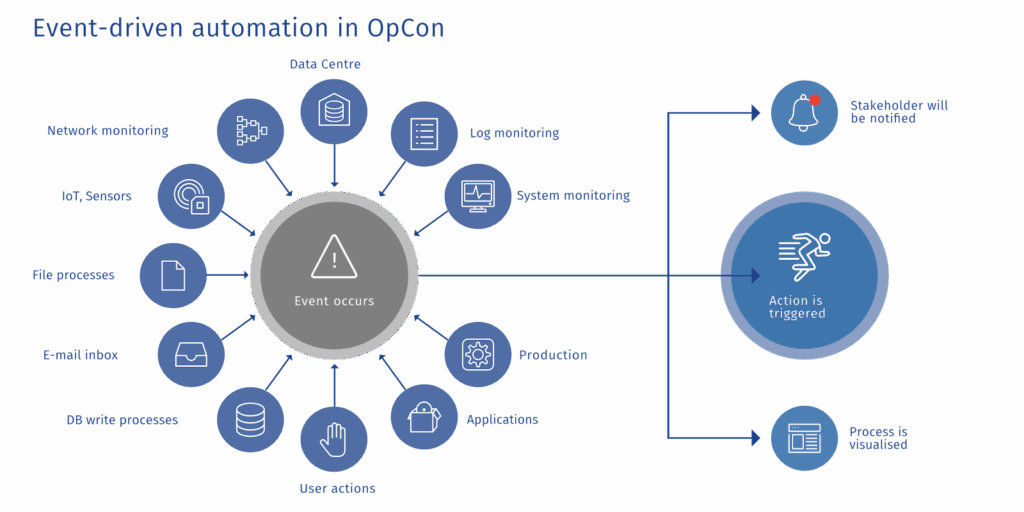
Workloads digitalised in OpCon can be triggered by events such as e-mails, user actions, specific environment sensors or system notifications. Almost any action can act as an event, no matter the source: a speech activated device, the IoT, mobile or portable devices, or the Cloud. DevOps and disaster recovery are examples of complex process automation that must be made available and run in a simple and agile manner. Event driven process automation enables proactive and adaptive process management that can significantly improve organisational and IT environment efficiency and reaction speed.
Oversight and resource monitoring
OpCon’s “Vision” module offers extensive monitoring functions for oversight of initialised processes. The module enables real time visualisation of the up-todate scheduling of current jobs. It also gives users the ability to intervene if needed. Just one click locates the source of occurring errors for quick fixes. Additionally, OpCon can monitor file transfer processes and indicators such as CPU loads, available memory and others. Many customers rely on the ability to monitor file transfers daily – not surprising, given that often, thousands of files are processed every day.
Disaster recovery
We know how important it is that system recovery happens in a timely manner, not least for disaster recovery and business continuity purposes. OpCon can be linked to existing disaster recovery plans without impacting on your recovery point objective or recovery time objective. It is precisely in stress situations like these that process automation can reduce errors. Automation processes have proven to be an excellent way to improve tests, process safety, and end-to-end recovery procedures.
Documentation and logging
OpCon includes a variety of modifiable standard reports that provide information about automated systems. Creating and distributing reports can happen automatically to meet the needs of all individuals
involved. Modern automation tools must enable robust handling of errors to ensure that processes run reliably and smoothly. That is why one central aspect of OpCon is its ability to handle errors, which involves an iterative error logging process. This method allows for efficient identification of errors, which can then be
analysed and fixed. Closely related to the error logging process is the monitoring module called Vision. Vision gives you the ability to navigate to the source of errors within the GUI.
CICD integration through OpConResource automation
With OpCon you can integrate DevOps principles into your IT operations and your service management, turning it into a business-wide platform for digital process automation. You can focus your IT on systemcritical aspects and substantially reduce your script volume. In turn, this frees up valuable IT resources for higher level tasks. You can use OpCon’s extensive cloud management to import workloads at pre-defined times, to apply transformation rules and to simulate the planned changes. Selected workloads are only transferred to the OpCon server once these preliminary steps are completed. The deployment process checks each target workload for changes since the previous deploy. This step ensures that manual
corrections to the target workload are not overridden. Version control within OpCon means you can restore
previous versions at any time which protects you against loss of data during the automation process.
- Extensive set of immediately usable connectors
- Interoperability using APIs
- Quick visualisation with OpCon Workflow Design Studio
- Central script management
- Manual orchestration of job starts, DB updates, patching and more.
Lights out management
Constant availability and increasing globalisation require IT that operates around the clock and often also an increased headcount. Users can get early alerts if tasks are taking longer or start later than they should. In addition, OpCon’s scheduling functions allow you to review and adapt planned activity minutes, days or months in advance, which gives you the ability to react to events and changes early. OpCon combines estimates of time requirements with realtime corrections and helps you to maintain effective control of your business processes while making sure you adhere to service level agreements (SLAs).
Dynamic process automation
OpCon’s functions include the option to tag individual tasks with a wide variety of parameter configurations and variables. This allows for highly contextualised execution of tasks and to execute them dynamically in different environments or machines and at different times of day, or ad-hoc. Dynamic task specification through variables saves staff time and effort in developing and maintaining business processes.
Seamless scalability
OpCon can grow in line with your automation environment. In just a few steps, you can create new
environments, implement scheduling and job control, visualise workloads and workflows across systems, set up self service functions, and integrate new business processes. Job control in OpCon supports parallel processing and load distribution across multiple systems with optimal system utilization.
Platform specific functions
Every operating system has its specific strengths. OpCon has components that put those strengths to best use. Components include, among others, message management, event management, operator replay, restricted task scheduling, step restart, file monitoring, and resource utilization.
Schedule management
OpCon has high performance scheduling and job control functions that calculate end of month, the next working day, and other complex scenarios which make it easy to complete tasks on time. Specific dates, and virtual calendars, are maintained over time. Dynamic visual calendars help you to ensure that future tasks are executed at the right time on the right dates.
Summary
Using OpCon offers you numerous advantages that substantially increase the efficiency and quality of IT processes. The automation of repetitive and timeintensive tasks creates greater business productivity and reduces errors. Staff can focus on value added activities rather than monotonous tasks, leading to
higher job satisfaction and more creativity. Another key advantage is improved process security and transparency. With OpCon you can comprehensively trace and document processes from start to finish, with significant advantages for internal controlling and compliance. In addition, OpCon makes your processes more scalable because they can be adapted flexibly to growing requirements and changing contextual factors.
And finally, the integration of automation tools contributes to cost efficiencies. Avoiding manual interventions means reducing running costs while at the same time also shortening processing times. In turn, you can more quickly react to changes in the market and become more competitive. Implementing OpCon is, to sum up, an investment in your future which helps you to optimise business processes, reduce costs and sustainably increase the quality of your services and products.
Optimise process automation across all areas