
CICS Analysis Workbench (CAW)
the Swiss Army Knife for every CICS
CICS Analyse Workbench CAW is a powerful and comprehensive tool used to monitor and analyse application data and gain valuable insights. No matter whether you need to optimise performance, troubleshoot, or plan capacity, CAW has a wide range of functions tailored for all eventualities.
Advantages:
Real time access to VSAM, DB/2, ADABAS, and TS/TD QUEUE
Knowledge transfer to a new generation of CICS programmers
Performance management
Support for software and compliance audits
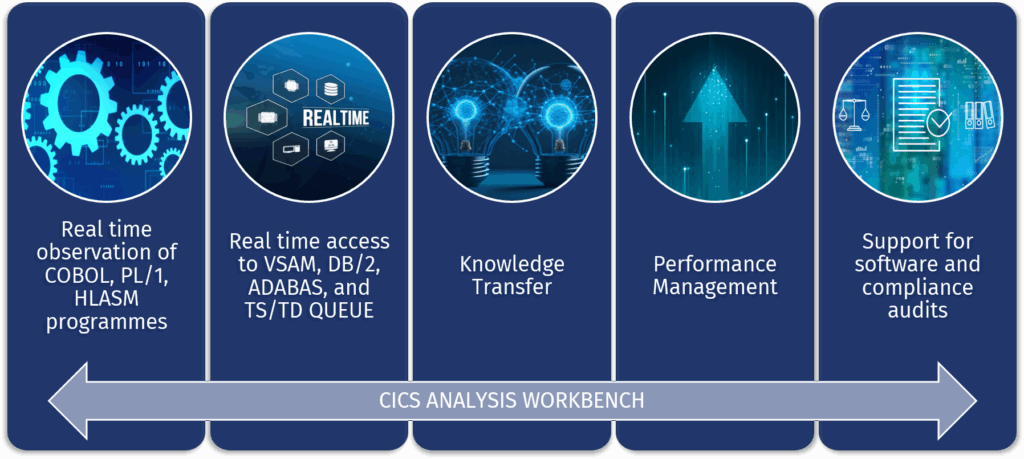
Real time observation of COBOL, PL/1, HLASM programmes
Using CICS Analyse Workbench, programmers can monitor and observe their applications in real time.
This real time observation enables in-depth examination of programme flows, quick identification of potential problems, and their removal – no matter whether this be classical debugging, performance optimisation or monitoring critical processes. With CAW, you don’t have to first use a classical debugging tool such as CEDF or even code instrumentation to generate actionable insights!
Seamlessly integrated analysis tools also give programmers the means to gain valuable information about programme execution time, resource usage and any potential bottlenecks.
All in all, tracing of COBOL, PL/1 and HLASM programmes supports the efficient development and maintenance of mainframe applications and contributes to improved overall performance.
Real time access to VSAM, DB/2, ADABAS and TS/TD QUEUE
CICS Analyse Workbench comes with display and analysis functions for typical CICS data sources such as VSAM, DB/2, ADABAS and TS/TD QUEUE. These functions have a number of advantages for programmers and architects.
Firstly, CAW’s real time access to information enables a quick response to any eventuality. This is particularly important for critical situations requiring swift attention, to respond to client queries or to solve problems. Secondly, real time access to data sources improves data accuracy because the data viewed is up to date. All decisions made as a result are based on current and accurate information.
This leads to a more efficient exchange of information and eases collaboration between architects and programmers. Such collaboration benefits businesses with high transaction and data processing volumes in particular.
Finally, real time access to these data sources and queues improves programmer and system administrator user experience. Instant provision of information allows administrators to quickly access data and do their jobs more efficiently, freeing them up for other tasks.
Knowledge transfer to the next generation of CICS programmers
Continued use, further development and modernisation of related technologies necessitates passing knowledge on from one to the next generation of CICS programmers. There is wide-spread and growing concern that CICS, COBOL and PL/I could be forgotten when experienced developers retire. Should this happen, it would result in a substantial gap in the ability of businesses to maintain and further develop their CICS applications.
In this context, CICS Analyse Workbench plays a key role. It is important for CICS programmers to pass on their knowledge and skills to the next generation, who can then take on responsibility for the development and maintenance of CICS applications.
CAW supports training and mentorship programmes for young developers who benefit from practical collaboration and sharing of best practices.
The provision of comprehensive information makes the introduction to CICS and related ways of thinking much easier.
The consequence of all of this is a new generation with all the knowledge and skills necessary to maintain and develop CICS programmes.
Performance management
Performance management is an increasingly important part of IT activities, in particular in relation to mainframes and CICS, because they tend to represent user experience. And in addition, mainframes often host and support business critical processes that cannot fail.
CAW helps to quickly and reliably complete transactions. Functions supporting this include monitoring response times, identifying bottlenecks and solving performance issues. Performance tests can be used to simulate the effects of utilisation peaks on CICS systems and to take steps to protect scalability and availability.
CICS Analyse Workbench provides insights that help to improve programme performance through the use of modern programming techniques such as efficient algorithms and optimal memory access. In this context, too, monitoring reaction and CPU times is important to identify bottlenecks and resource problems.
Often, performance management within a mainframe environment requires specialist skills and tools. CAW comes with the tools needed to understand the system and to identify bottlenecks and improvement opportunities.
Support for Software and Compliance Audits
In today’s digitalised world, businesses rely on stable and secure IT infrastructure more so than ever before. Smooth and efficient functionality is of particular importance for mainframe systems like CICS so that business critical processes can run without interruption. Simultaneously, businesses have to adhere to legal and compliance requirements including GDPR. Guaranteeing the integrity and security of software and compliance audits in mainframe environments requires professional support. Enter ITIL best practice (IT infrastructure library). ITIL offers best practices and comprehensive guidance for effective and efficient IT services support. CAW supports you to meet all these requirements, standards and guidelines.
CICS Analyse Workbench provides tools and techniques for effective support for software and compliance audits.
This includes monitoring transactions and processes, identifying irregularities or deviations, execution of safety and risk analyses, and a variety of reporting options.
Case study
A finance company that processes a large volume of transactions uses CICS Analyse Workbench. The company uses data sources such as VSAM, DB2 and QUEUEs to underpin smooth business processes.
Suddenly, a programmer registers that problems in transaction processing lead to errors. Instead of spending ours reviewing logs and reports, the programmer uses CAW’s display and analysis functions to access information in real time.
This real time access to data sources provides the programmer with up-to-date information about what is causing the observed errors. With this information to hand, the programmer is able to take appropriate steps to quickly solve the issue and restore normal business processes.
Real time access to data sources also improves the accuracy of the data used which means that the programmer can be certain that what they are looking at is the current picture, without any delays.
Efficient display and analysis functions within CAW also support productive cooperation between analysts and programmers, who can instantaneously access all the information they need to make fast and accurate decisions. The company’s high transaction and data processing volumes make this particularly important.
Conclusion
In sum, CICS Analyse Workbench gives programmers a real time view of their COBOL, PL/1 and HLASM programmes. In turn, this allows them to monitor their applications and to quickly identify and solve any problems.
Integrated analysis tools offer valuable insights into programme execution times, resource usage and bottlenecks. Real time access to data sources including VSAM, DB/2. ADABAS and TS/TD QUEUE enable swift reactions when problems occur, improve the accuracy of data used, and efficient information sharing.
CAW supports knowledge transfer to new generations of CICS programmers and makes it easier to train and mentor them.
It underpins performance management tasks such as monitoring response times, identifying bottlenecks and addressing performance issues. CAW helps you with software and compliance audits through its ability to monitor transactions and processes, identify irregularities and create reports.
All in all, CICS Analyse Workbench contributes to efficient development and maintenance of mainframe applications and guarantees a stable and secure IT infrastructure with maximal cost and resource efficiency.
Real time observation of COBOL, PL/1, HLASM programmes