Automatic code scans uncover safety vulnerabilities in minutes. Kiuwan Code Security (SAST) is available as an affordable SaaS or on-premise solution for teams and companies of all sizes. Kiuwan SAST checks and confirms code compliance using the most stringent security standards such as OWASP and CWE and flags any existing weaknesses. It covers all key languages and can be easily integrated into the leading DevOps-tools.
Advantages
Fix problems and vulnerabilities more cheaply and quickly
Create better software from day one
Appropriate for all development approaches, including Agile and DevOps
Avoid problems and vulnerabilities from day one in DevOps processes
Use a consistent model and approach for code analysis across your organisation
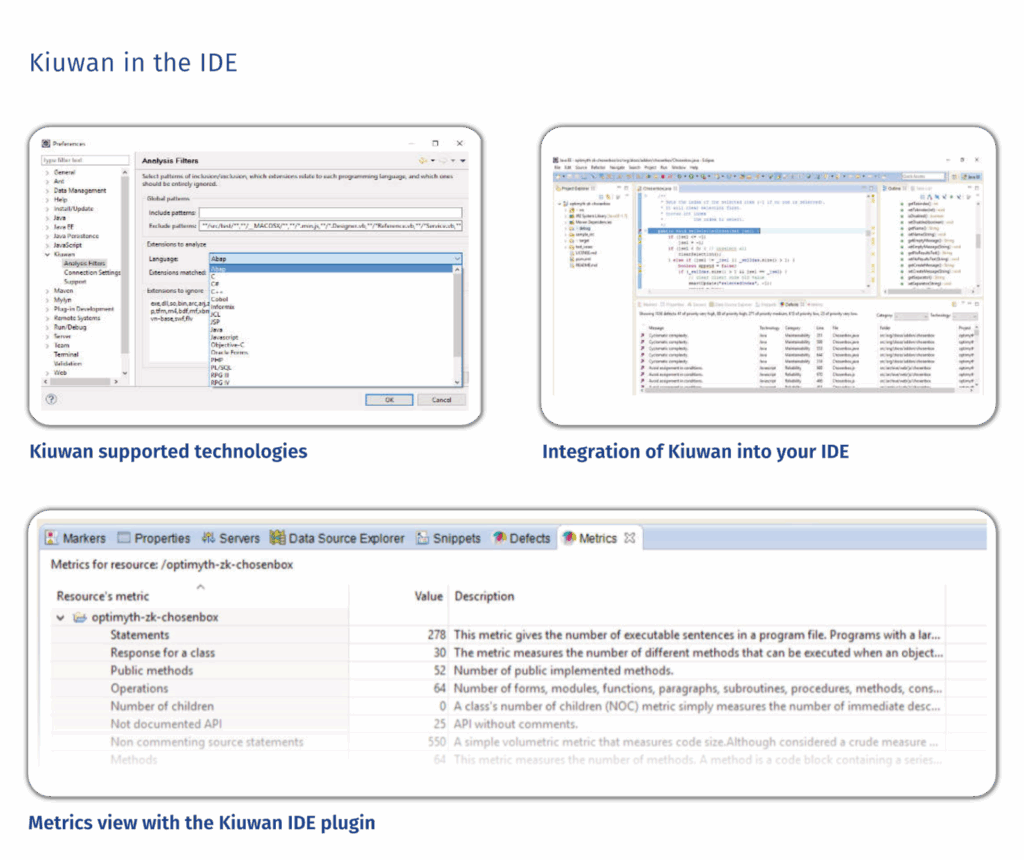
Conduct automatic code analysis in the IDE each time you save your code
Ensure local analysis of your entire code before it is transferred to the code repository
Transform DevOps into DevSecOps
DevOps represents a milestone for agile software development. Within the software development lifecycle (SDLC), DevOps is a response to the speed and expandability needed for success in today’s environment. But what about security? The “old school” approach was to ask security experts to test and review applications following completion of their development. However, Kiuwan’s flexible integration options mean that code security tests can become a core component of each SDLC phase.
Why Kiuwan?
Kiuwan Code Security is a cutting edge SAST solution. There is much more to it than only its ability to conduct static security analysis. With SAST, Kiuwan aimed to achieve fast and accurate results. SAST is easy to install, has an intuitive user interface and comes complete with an extensive start configuration. Kiuwan reduced the implementation time substantially to just a few days. Scan results are available in seconds rather than days, are highly accurate and have a low false positive incidence. The solution is highly configurable to suit your specific needs.
Additional functions
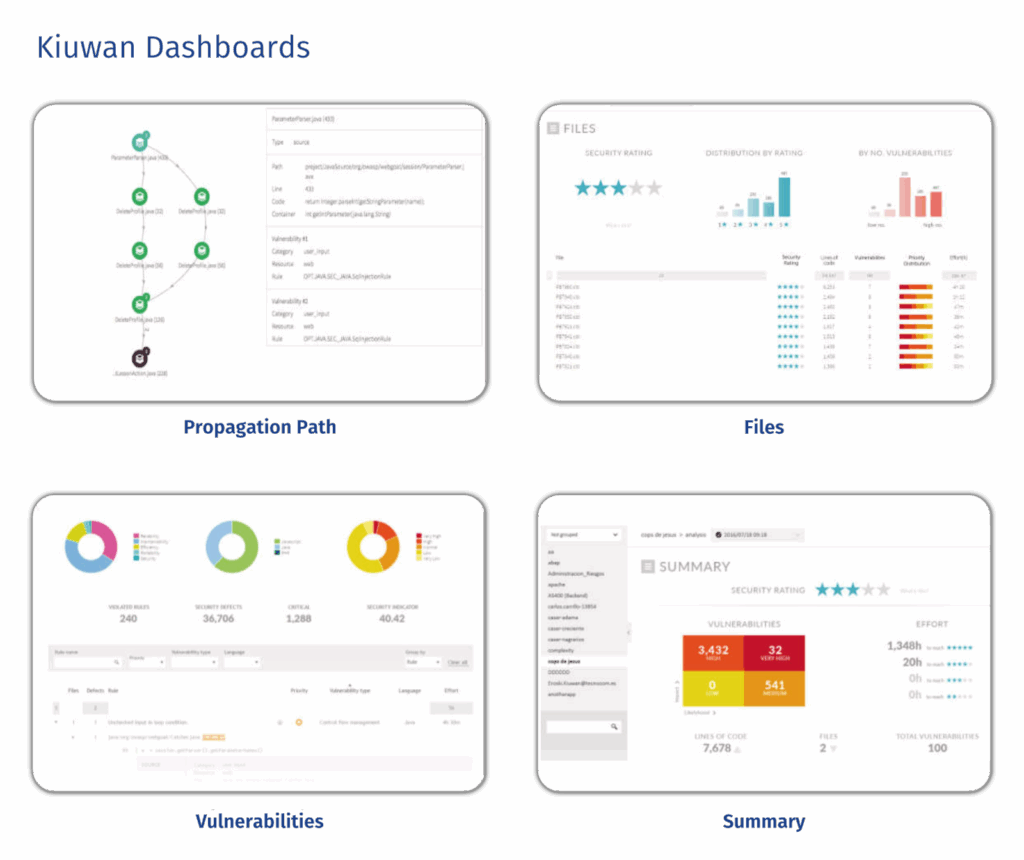
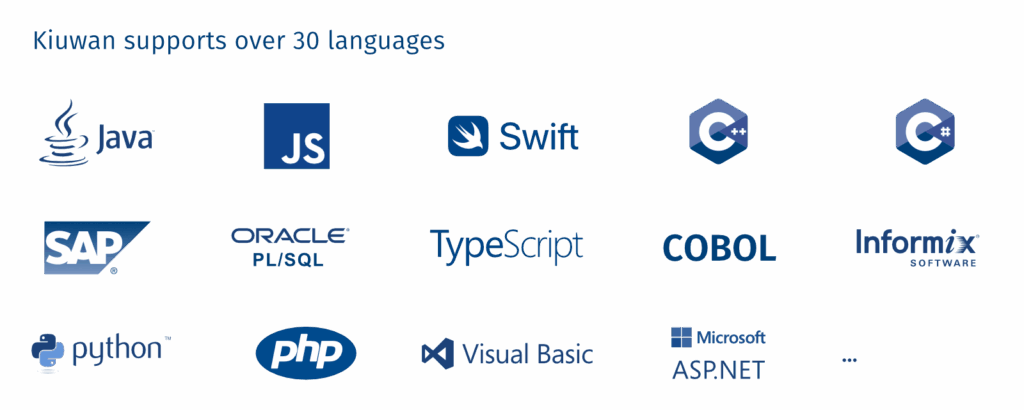
Kiuwan Code Security provides a comprehensive overview of all security vulnerabilities identified in the source code. It uses industry standard criteria to assess the threat level inherent in identified vulnerabilities. You can create action plans to fix weak spots by either estimating the amount of developer effort needed or defining your target assessment. You determine how you want to evaluate application risks. As a multi-language solution, Kiuwan Code Security covers most programming languages which means that every single application can be tested.
Vulnerabilities that Kiuwan detects:
Uninitialized variables
Application misconfiguration
Predictable access- or session data
Directory indexing
Insufficient authorisation / authentication
Automatic reference counting
Faked cross site requests
Information leaks
Insufficient transport layer protection
Insufficient binary protection
Scripting independent of location
Injection attacks
Inter-process communication
OS command
Insecure cryptography
Buffer overflow
Free non-dynamic variables
Use after free
Double-free / double-close problems
Format string weaknesses
Pointer variable access to local variables
SQL injection
… and more
Reliability problems:
Race condition
Division by zero
Deadlock scenarios
NULL pointer dereference
“It takes just one glance to see any risks related to your project.”
ThinkApps
Key characteristics of the Kiuwan IDE plugin:
Easy installation. All you need is the IDE of your choice, a Kiuwan account with the IDE plugin, licences for your developers and an internet connection.
Compatible with different IDEs. Kiuwan includes plugins for Eclipse, JetBrains, MS Visual Studio, VS Code and others.
Kiuwan adapts to your needs. Filter errors by their occurrence on file, package, application or workspace levels.
Practicality. Selecting a problem in the dashboard takes you directly to the relevant file and line of code.
Everything at a glance. The editor highlights the affected file, prioritises the error and provides useful tool suggestions.
Expandable functionality. Additional dashboards can display code metrics such as program complexity.
Easy maintenance. The plugin benefits from automatic updates.



Fix problems and vulnerabilities more cheaply and quickly