Quality assurance and error analysis in development and migration projects
Common unit tests and especially regression tests dominate quality assurance for COBOL application modernisation and COBOL migration projects. Typically, these consist of a set of original data, a scenario and a set of results data. When scenarios are executed on different systems or different versions using the same original dataset, the resulting data should always be identical to achieve audit compliance unless observed differences were intended as part of further development activity.Highway61 supports and facilitates regression tests by making it possible to take a closer look at programmes as they run through scenarios.
Advantages
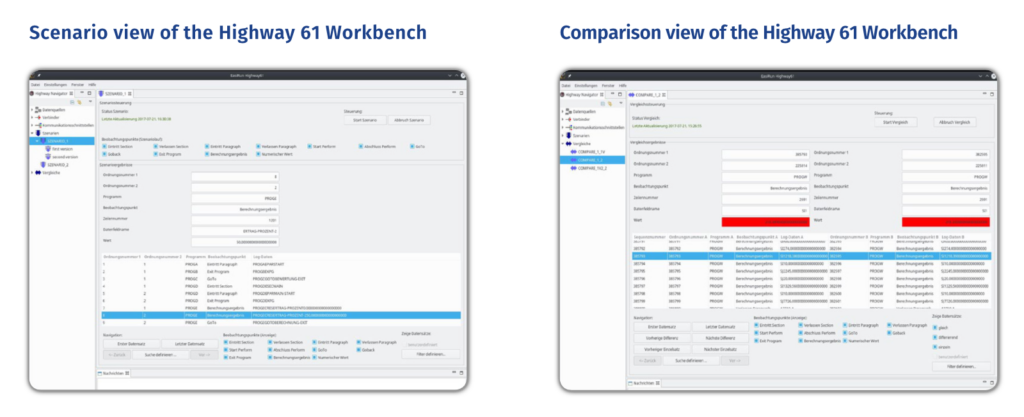
Modern user interface including useful tools for troubleshooting
Potential for regression tests on different system platforms
Reduced time spent on development and debugging through easier troubleshooting
Integration into existing build and test platforms (ANT-Task, command line API, Java API for integration into JUnit test scenarios)
Archiving scenarios supports integration with audit compliance
Regression test results primarily evidence the identity of function for different scenarios on different systems or versions. They tend to be easily doable and can be just as easily automated which makes such tests the go-to option for complex software systems. However, this complexity also causes a key weakness of these test procedures: they can only determine whether or not it is highly likely that the system will work as intended and without errors. If errors do occur, system complexity makes it difficulty to pinpoint where they occur, even with detailed knowledge of internal processes. This is where Highway61 comes into play by making it possible to take a closer look at the programmes as they run through scenarios. This enables developers and others to see where and when deviations happen and to examine intermediate results throughout the test. In most cases, this in turns means that the causes of errors can be narrowed down effectively, resulting in saved time and resources spent on troubleshooting and supporting auditing purposes.
Highway61's key components
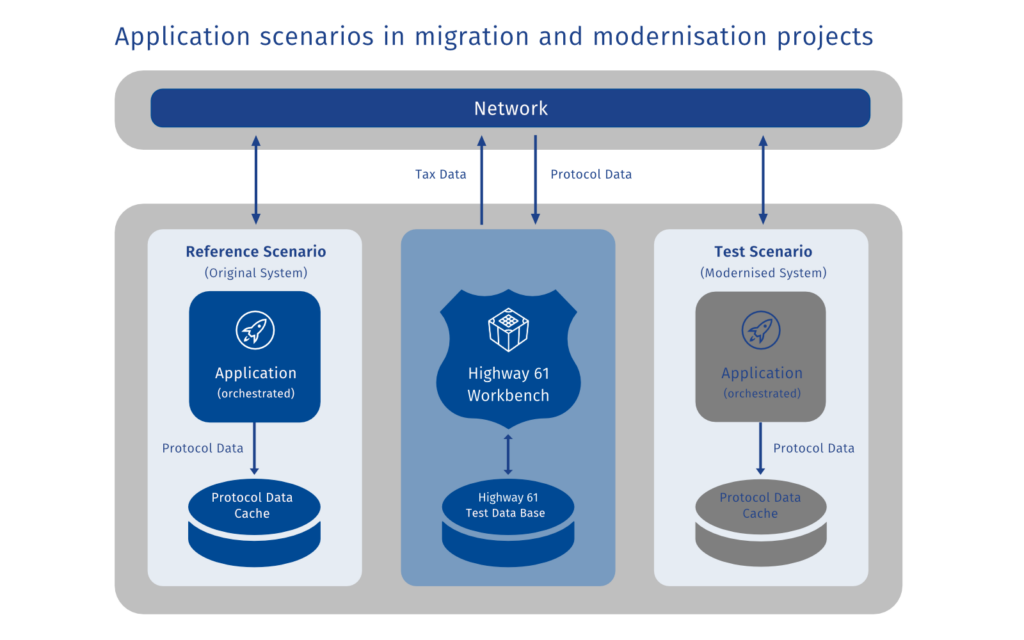
The key working principle of Highway61 is that it records information at certain points of interest which can then be compared with the corresponding information gathered in other programmes on other versions or other systems.
The product comprises of four components that are integrated into the development process:
Pre processor which instruments the code
Runtime environment that records all information
workbench with interfaces for different operating systems
Batch-interface that supports integration in build and test platforms
The pre processor is based on EasiRun’s proven transformation technology and is responsible for instrumentation of the COBOL code. Instrumentation consists of adding code to the original source code. The purpose of this added code is to record information. This code is independent of the COBOL compiler used. It provides information in similar formats irrespective of the compiler.
The runtime environment works with the added code to record a comprehensive protocol of all information regarding the COBOL applications of interest. We deliver the runtime environment as source code and can, where needed, adapt it to any specific characteristics of the test environment.
You manage different scenarios on different operating systems via the Highway61 workbench, which also allows you to remote start the scenarios. Via the workbench you can analyse large volumes of protocol data generated during the scenarios.
The batch-interface integrates Highway61 tests into different build and test environments which means that Highway61 can be used in continuous integration processes and nightly builds just like any other test framework. You can chose from different interfaces:
command line interface
Ant-Task
Java API (eg, for integration via Junit-framework)
Highway61 is currently available for all LUW systems (Linux, UNIX, Windows). On demand, we offer connectors for various mainframe systems (z/OS, z/VSE, BS2000) and other proprietary systems. With Highway61 you can archive records of your scenarios to later compare archived records with results of other scenarios, including with different codes.
This function supports you in a range of ways. On the one hand, you can prove that a scenario’s control flows are not affected by changes and on the other hand, you can determine that a control flow changed as intended. Archived results are useable for auditing purposes.
Highway61 is built for the following primary purposes:
further development of existing applications
migration and modernisation projects
In the context of further developing existing applications, Highway61 offers audit safety by allowing your teams to review, replicate and document changes to control flows. Where unexpected changes occur, Highway61 efficiently pinpoints potential causes of errors. This generally reduces troubleshooting efforts substantially.
In modernisation and migration projects, Highway61 helps you to compare how the application behaves in the modernised system with how it behaves in the legacy system. This is possible because Highway61 records log data consistently irrespective of different systems, compilers and platforms used, thereby guaranteeing direct comparability. The result is significantly reduced time and effort spent on locating errors.


Modern user interface including useful tools for troubleshooting