
Many ways to bring your application to Java
P3/COBOL is not just any COBOL cross-compiler, but a complete solution for application modernization and migration that offers maximum security at a calculable cost.
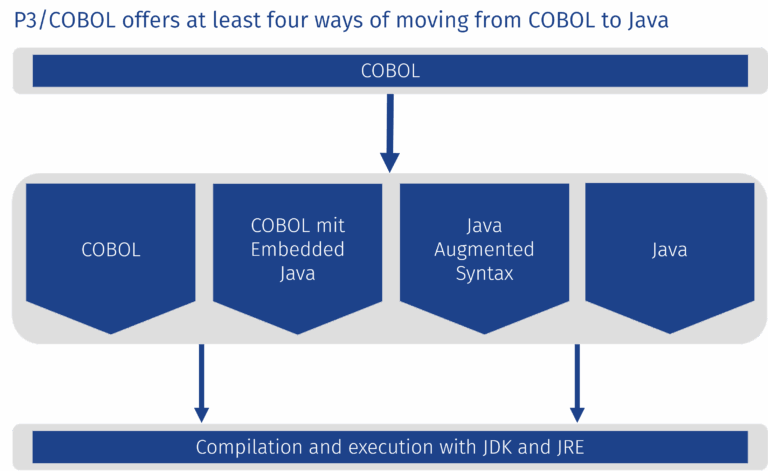
There are basically four options available to you:
-
- Keep your pure COBOL while compiling to a Java source and then use the JDK or JRE for compiling or executing.
- Choose a mixture of COBOL and embedded Java at developer level, and then use the JDK or JRE for compilation and execution.
- Convert your COBOL sources into our Java Augmented Syntax: Compile to a Java source, and then use the JDK or JRE to compile or execute.
- Compile in a single step towards Java and maintain your Java sources from now on.
Advantages
Use COBOL developers for Java development
Smooth transitions
No loss of performance
A proven technology that creates 100% Java code
You can exercise these options in any conceivable combination, which also allows you to continuously optimize your COBOL code in order to obtain better Java code in the process.
All these options are compatible with a COBOL or Java strategy and complement it in every conceivable way.
One of the biggest challenges of the software world in the 21st century is to expand a company’s technology base without having to give up years, if not decades, of valuable development work.
The existing software structure often comprises a company’s most valuable software resources, with which it often clearly differentiates itself from its competitors.
P3/COBOL was designed and developed precisely for this purpose.
The architecture of P3/COBOL is based on the premise that the developer sees COBOL as a specification for the system of tomorrow – and not as an archaic, dying programming language.
Java Augmented Syntax
Java Augmented Syntax (JAS) is a set of COBOL language extensions that facilitate the incremental migration from COBOL to Java.
Strictly speaking, JAS is a tool for formulating rules in COBOL that can be harmonized with the corresponding rules in Java.
This means that the rules can be modeled or reproduced in Java using an extended syntax without in-depth knowledge of the COBOL business logic.
With the JAS tool, P3/COBOL can effectively migrate the proven COBOL business logic to Java.
This significantly increases the security and efficiency of the complete Java implementation.
JAS makes it possible to express the proven algorithms within COBOL with a Java syntax extended by context information for the localized application.
This information is securely “transferred” into a Java context.
This requires at most a limited understanding of the transferred code.
This procedure is in stark contrast to the usually very laborious “rewriting” of a COBOL program in Java.
Although functionalities can be reproduced one-to-one when rewriting, the Java code created is neither expandable nor maintainable.
This is largely due to the high information content of the COBOL program logic, in which a relatively low density of necessary calculations contrasts with a large amount of “junk code”, which must be kept as long as its true use has not yet been recognized and explicitly named. JAS facilitates the piecemeal “reformulation” of COBOL logic and enables more precise recognition.
When a programmer takes on the same application transformation by hand, his understanding of the entire legacy application must be so comprehensive and first-class that it seems unlikely that every programmer entrusted with the task has this top knowledge.
As the size of the application increases, the gap between those who understand the code and those who convert the code grows diametrically.
The necessary interaction between programmers fails to materialize in large-scale applications and the venture fails unless great effort is made to complete the task and sufficient time is available.
Time is the critical factor: many legacy COBOL applications cannot be completely migrated before it becomes necessary to modify or update the original application.
This means that a feedback path must be introduced for functional changes, which further exacerbates the time planning.
With P3/COBOL and JAS, on the other hand, the fully automated conversion of the proven COBOL sources to 100% Java code and the subsequent migration of the rules from the automatically generated code to manual Java code can be accomplished with considerably less risk and planning uncertainty than is the case when rewriting the application.
Anyone who is familiar with the design and implementation of the application and business rules of the legacy application can use JAS in COBOL to further develop certain parts of the application in such a way that the original behavior is mapped in a context that any Java developer can rewrite in handwritten code.
This developer then only needs the limited knowledge of the part he is currently converting.
In addition, this manual conversion can be generated locally in the operational COBOL application as Java or externally as handwritten Java classes.
This code, together with the functionally generated Java, is constantly available for repeated checks of the functions during the transformation process.
This enables a truly incremental and risk-controlled approach to migration.
P3/COBOL and the cloud
Reduce the technological gap
All legacy applications have what is known as an ‘IT backlog’: use customised cloud software to keep the IT backlog as low as possible by continuously performing, checking and logging your activities.
Benefit from As-A-Service solutions
Cloud stacks are ideal for business software because they provide a central platform for controlling processing, storage and network resources.
Utilise only top-quality solutions
Standards enable interoperability and flexibility – they promote innovation and growth.
Reduce your
overall costs
Cloud solutions offer major advantages: impressively short implementation times, fast ROI — and the responsibility always lies with the provider, while costs remain low.
Why you need P3/COBOL
P3/COBOL is a system that is based entirely on Java and compiles your COBOL applications into directly readable Java source code.
No native C or C++ add-ons are required to perform high-performance calculations or similar.
P3/COBOL relies on pure Java functions for performance optimization so that you do not have to leave the current JVM.
In addition to Java, P3/COBOL is also compatible with other equally important technologies.
This is made possible by XML import and export functions, compatibility with any COBOL file system and a relational database or the ability to reengineer applications step by step.
We can therefore say with certainty: P3/COBOL generates 100% Java code.
Paragraphs, statements or interface routines can be reprogrammed and integrated faster.
Other powerful tools integrated in Eclipse such as profiling, development and debugging support you in each of your modernization steps.
A flexible plugin for Eclipse
P3/COBOL not only supports you in placing your application in a modern world, it also provides your development team with a state-of-the-art development environment.
P3/COBOL is based on Eclipse, the most widely used platform in the Java environment.
The plugin has a modular structure to provide you with the best possible support for your mainframe development.
The numerous modules of the plugin
Project management – Create COBOL projects with ease and start developing your software within seconds.
Combine COBOL and Java resources within a project and use the respective repositories.
Outlines & Hyperlinks – Navigate through your existing sources faster than ever before, or jump to the variable definition with just one click.
Enjoy always having a complete overview of your source to be edited.
Relationships – If you have a complete overview of your project, you have a clear advantage.
You can see at a glance which copy routes and subroutines are used in your program.
Using “Show Dependencies”, you immediately receive a list of the COBOL programs in which your current copy path is used.
Debugger – Develop more conveniently than ever.
With the P3/COBOL debugger, you can get to the scene of the action that you want to examine in more detail.
Attach yourself to running processes or search for the error on a remote system.
Thanks to its modular structure, you can use the P3/COBOL Eclipse plug-in with our P3/COBOL compiler or as a development editor for mainframe applications.
The connection options for source control systems make the exchange of modified sources even easier and more effective.
A common basis for COBOL and Java developers